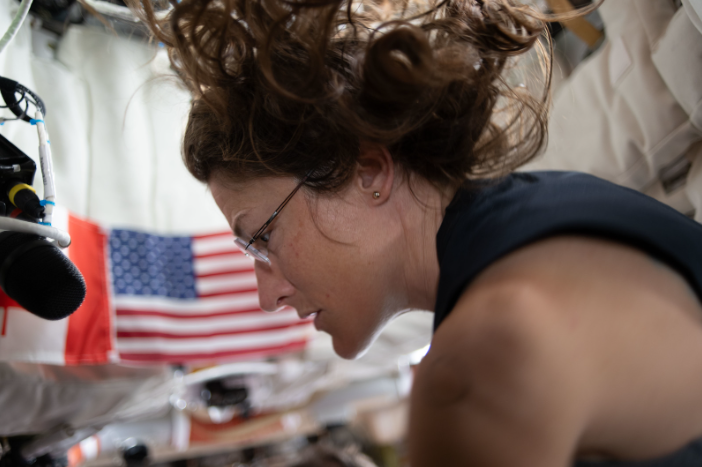


On April 1, NASA launched the Artemis II mission, a ten-day space flight around the Moon. Piloted by a four member crew including Reid Wiseman, Victor Glover, Christina Koch, and Jeremy Hansen, the ultimate purpose of their mission was to test the life-support systems of the Orion capsule. However, the trip included an additional plethora of historical achievements and heartwarming moments.
On April 6, Canadian astronaut Jeremy Hansen radioed into mission control to request that they honor their mission by naming two undiscovered craters on the Moon. According to NBC News, “One of the craters was dedicated to the wife of Artemis II commander Reid Wiseman, Carroll Wiseman, who died of cancer in 2020 at 46,” giving a new meaning to the phrase, “I love you to the Moon and back.” Wiseman described the crater as a bright spot on the Moon and the crew requested that they named it Caroll, after which the crew shared an emotional embrace. Looking into Reid Wiseman’s NASA profile, Carroll Wiseman “dedicated her life to helping others as a newborn intensive care unit Registered Nurse.”
Several scientific operations also took place on the Artemis II mission. One of the most notable of these experiments was AVATAR (A Virtual Astronaut Tissue Analog Response). According to NASA, it was a “collaboration between NASA, multiple government agencies, and industry partners that seeks to gain a deeper understanding of human biology and disease, preventative measures, and personalized therapeutic treatments.”
AVATAR was developed by Harvard’s Wyss Institute, and was an experiment that used organ chips to study how deep-space radiation and microgravity impacted living human tissue. In addition to this experiment, the crew also conducted several manual piloting tests, where the astronauts piloted the Orion capsule to test its responsiveness and control. The crew also completed a study on spaceflight standard measures, where they collected data on nutritional health, cardiovascular function, and physical performance to assess the impact of deep space travel.
Many of these experiments featured the monitorization of radiation, but they also utilized personal dosimeters (radiation sensors), as well as sensors throughout the Orion to monitor radiation levels.
The Artemis II mission was a lunar flyby that set the record for human distance from earth, reaching a maximum distance of 252,756 miles from Earth, which surpasses the record set by Apollo 13. Artemis II also featured a diverse crew, earning the achievement of being the first mission to take a woman, personal of color, and non-U.S. citizen into deep space. The crew documented roughly 10,000 high resolution images of the Moon, featuring both the dark side of the Moon and the terminator line (a boundary between night and day).
As important as it is to list the achievements of the Artemiss II mission as a whole, it is equally important to honor the achievements of the crew members individually. Commander Reid Wiseman, led the first crewed lunar mission in over 50 years, in addition to being the oldest person to travel beyond low Earth orbit. Victor Glover, the flight’s pilot, became the first person of color to travel to the Moon.
Christina Koch, one of two mission specialists aboard the Orion became the first woman to fly around the Moon, and she also holds the existing record for the longest single space flight made by a woman. Last but not least, Jeremy Hansen, the second mission specialist aboard the flight became the first Canadian and the first non-U.S. citizen to travel to the Moon. Overall, the Artemis II Launch was both a successful and historical achievement for NASA, one stocked with many individual victories, heart-felt dedications and many record-breaking moments. The 10-day mission has paved the way for future NASA successes to come.