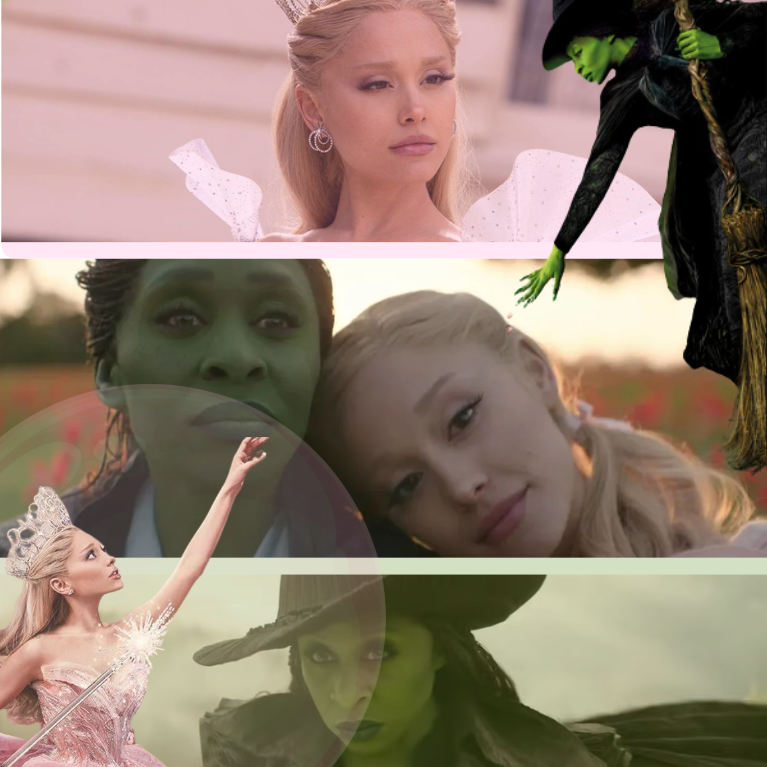
“Are people born wicked or do they have wickedness thrust upon them?” The musical, “Wicked”, which is the basis of the recent movie adaptations, challenges its audience to look past the surface of a story they thought they knew. Throughout both “Wicked“(2024) and “Wicked: For Good”(2025), there is an uncanny amount of symbolism, to the point that it takes multiple watches to even notice all of the connections. These works have a vast amount of complexity, which is conveyed through the use of visual symbolism, musical symmetry, and calculated foreshadowing. While the movies guide the viewer’s focus toward the friendships and dynamics, the plot is also driven by other attributes designed to resonate subconsciously, shaping your perception of the story.
Redefining Oz
The 1939 film, “The Wizard of Oz,” focuses its attention on the protagonist, creating large gaps in the Wicked Witch of the West’s origins. Essentially, the only thing you know about the supposed villain is that she is evil and green. “Wicked” fills in these gaps and builds a complicated and heart-breaking story around all that happened before and after the events portrayed in the Wizard of Oz. It builds on the idea that Elphaba, the Wicked Witch, was always punished for being green, whether it was by her father or other students at Shiz. Even the Wizard uses her color against her to enforce negative ideas. This story inherently causes the audience to question who the real villain of the story is, not just through the dialogue, but the unraveling is embedded in the music.
The Music
The music itself can be seen as an omen throughout both films. The seven-note melody of “Unlimited” first appears in the song “The Wizard and I,” and is used to show Elphaba’s hope and overall excitement to meet the Wizard and inflict change. This melody reappears in the final song of Act I, “Defying Gravity,” where it is now faster and louder, to show her determination and resentment towards the Wizard. Finally, in the last song in Act II and the musical itself, you hear these notes again in “For Good,” but now these notes that once represented ambition have turned into acceptance. This melody also pays homage to its origins, “The Wizard of Oz,” as it is a manipulated version of “Over the Rainbow,” the song Dorothy sings when she too feels lost and undermined. This connection symbolizes the impending doom that was trailing Elphaba since the beginning, and signifies the idea that all great things must come to an end. In “Wicked: For Good”, the musical shows a change in both Glinda and Elphaba in its song “For Good.” In “For Good”, towards the end of the song, Glinda and Elphaba switch harmonies, with Elphaba now singing the higher note, and Glinda singing the more grounded, lower note. While this was a minor change, it truly embodies the amount of love they both hold for each other and the growth they have undergone because of their friendship.
Foreshadowing and Symbolism
“Wicked“ uses foreshadowing and symbols to indirectly express the power of the story, but also to show the complexity of each individual character. In “Wicked: For Good,” Glinda is getting married to Fiyero, who is seemingly distant, and Glinda once again feels alone. While Glinda is getting ready for her wedding, by herself, she goes through the traditional things she must have in her wedding, along the lines of ‘something old, something blue, something new,’ but with Oz-like names. However, when she says ‘something oldish’ she picks up a pink flower identical to the one she gave Elphaba when she said, “Why Miss Elphaba look at you. You’re beautiful,” symbolizing the beginning of her friendship with Glinda. Additionally, after Glinda said that quote in the first movie, the final notes of “For Good” play, once more showing their friendship had a time limit. At this point, you can tell Glinda knows that her only real friend, Elphaba, won’t be there, so she puts this flower in her own hair as her ‘something oldish.’ Later, when Elphaba unexpectedly lands on Glinda’s apartment balcony, Glinda takes the flower out of her hair to greet the one person she needed on her wedding night, Elphaba.
Additionally, in one of the last clips, Glinda is alone with all she has left of Elphaba, the grimmerie, and she sings a reprise of “For Good” while staring out into the sky. But there is a green setting behind her, and then it pans to Elphaba in the undiscovered desertland with a pink background, singing back at her. While there is a break in the singing, a choir sings “No One Mourns the Wicked,” and then suddenly the grimmerie opens for Glinda. This scene is so symbolic because it represents the final message of the friendship, they will always have a piece of each other with them, that they have been changed for good, and that someone always mourns the “Wicked”.
In the closing scene, it shows a flashback of Fiyero, Glinda, Boq, Elphaba, and Nessarose in a tulip field. First, you see Fiyero with his arms stretched out perpendicular to his body, symbolizing his future scarecrow self. On the left, you see Boq with a hat looking like a funnel, similar to his later Tin Man form. Additionally, everybody looks like silhouettes except for Glinda, emphasizing the idea that Glinda will be alone for the rest of her life and be the only person left out of that group. This scene ends by honoring the Broadway version of the musical, by copying its playbill of Glinda whispering in Elphaba’s ear. By ending with a flashback, it creates a powerful ending that contrasts with the story’s tragic, public opening (“No One Mourns the Wicked”) with a private, happy memory, suggesting this is the one moment Glinda, who once sought fame, will forever return to.
Conclusion
The use of foreshadowing, symbolism, and musical melodies makes you feel entrapped in the story and see the perspective of each character. This creates a violent sense of irony because, from the start, the audience is haunted by their knowledge of how the story will end. Through minor things like this, we see that Glinda is never supposed to know that Elphaba is alive because, in the end, the tragic separation is what leads to Glinda being truly ‘good’. We also realize that, while Elphaba always sought after change, she had to accept that she wasn’t “unlimited” and that she would have to entrust somebody else with this. It further emphasizes the idea that Glinda and Elphaba needed each other to get what they wanted, but didn’t realize that at the same time they would be forced to lose each other at the cost.