

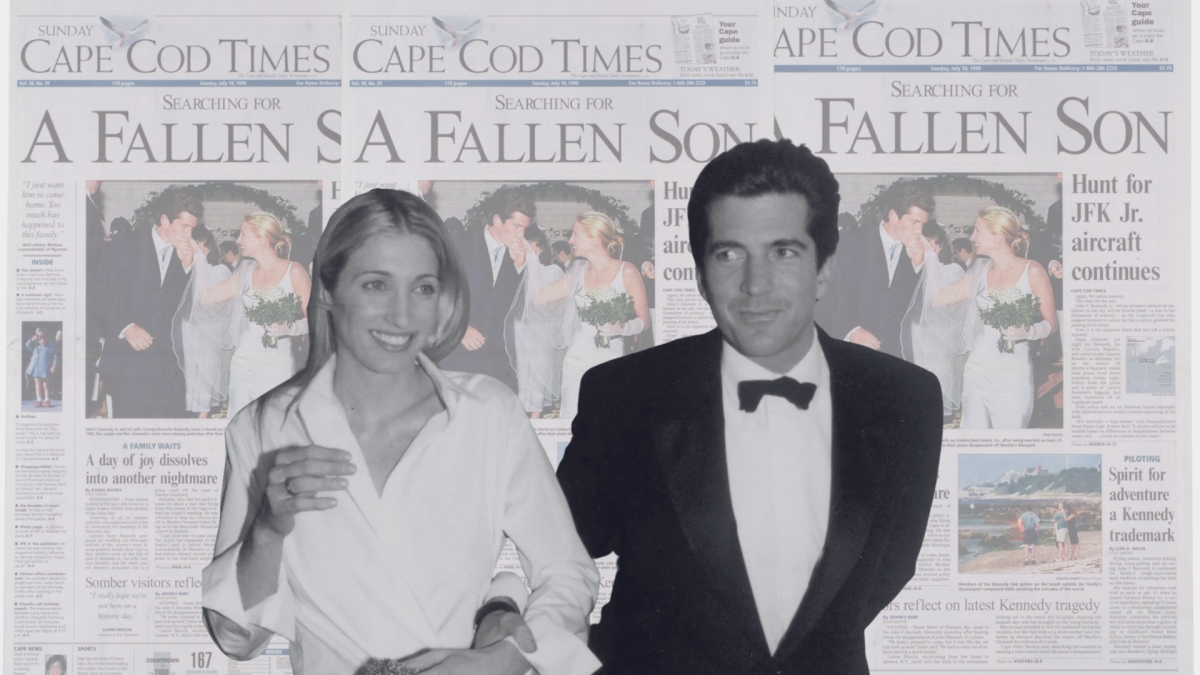
The obsession over John F. Kennedy Jr. and Carolyn Bessette is not new; in fact it has been persistent since the 1990s. But now, instead of the fixation being fueled by their tragic passing and rumors of toxicity, infatuation seems to be rampant due to the over romanticization of their relationship and the Kennedy experience.
Ryan Murphy’s new series, “Love Story,” officially premiered on Feb. 12, 2026, releasing an episode every Thursday. It focuses on the chemistry and inner workings of Bessette and Kennedy’s relationship. Bessette is painted as confident, strong and empathetic but still grounded, with complex emotional responses that captivate the audience. She embodies a complex female persona that is magnetizing to the public and press even today. The series highlights her professional life at Calvin Klein, where she made a name for herself as a high-ranking public relations executive. On the other hand, Kennedy is characterized as intelligent and dignified, yet constrained by immense privilege and notable personal mistakes. Initially, Bessette stands out to Kennedy because she isn’t interested in his name or popularity; she sees him as an equal. However, conflict starts early in their relationship. An anonymous letter attacking Bessette’s character causes an argument over public narratives and trust. The show’s fifth episode depicts their infamous 1996 fight in Washington Square Park, which was exhaustively covered by paparazzi and news outlets at the time.
Nevertheless, this show is not without critiques. “Love Story” was created by Connor Hines and produced by Ryan Murphy, an American director and writer who has received backlash for fictionalizing sensitive true stories. For instance, Murphy’s “Monsters: The Lyle and Erik Menendez Story” has faced intense criticism from the Menendez family and the brothers themselves, who labeled it a “grotesque shockadrama,” filled with “outright falsehoods.” When Murphy and Hines were making “Love Story” they never consulted the Bessette family nor the Kennedy families, casting doubt on its accuracy and intention. According to an interview with Vanity Fair, Jack Schlossberg, Kennedy’s nephew, stated, “I think admiration for my Uncle John is a good thing. What I don’t think is right is taking advantage of it in a grotesque way.” This ethical ambiguity continues to fuel the debate over the boundary between historical drama and exploitative fiction.
While “Love Story” leans into a scripted drama, people who were in the couple’s inner circle describe a reality that was much more suffocating. Friends and biographers often describe the relationship as deeply emotionally intimate, but the relentless surveillance of the press created unbearable strain. Unlike the unwavering, composed character portrayed on screen, sources close to Bessette-Kennedy suggest she felt hunted by the media, a factor that intensified tension early in their marriage. It wasn’t just about the big arguments in a park or on the street covered by the media, it was two people struggling to have a normal life because they weren’t being allowed one. Those who were close to them saw a couple that loved each other but were constantly pulled apart by the outside world. By turning their private grief into public entertainment once again, the series risks repeating the very exploitation it depicts.
The reason the public is still fixated on them today is partly because of how suddenly it all ended. A glimpse into Kennedy’s mindset comes from his former girlfriend, Christina Haag, who once experienced a near-fatal kayak trip with him. The two met as teenagers and went on to date for five years. At the time, Haag had recently broken her foot while horseback riding, and her doctor had allowed her to go swimming, but nothing more. Kennedy pleaded with her to go on a kayak expedition until she reluctantly agreed. She recalls him telling her to be a “trooper” and that they only had to go a little further. The waves began to become increasingly violent, the sun had gone down, and neither of them had life jackets. Haag begged him to finally turn around. After almost crashing into a boulder, a wave took them both under. In Haag’s memoir she recalls that, while she was fighting for her life, he was totally calm. After reaching safety Kennedy said, “Yeah, Chief, but what a way to go.”
His father’s violent and televised death likely caused Kennedy to have a willfully reckless nature, providing a backdrop for his decision to fly in 1999. The couple was planning on dropping off Lauren Bessette, Bessette’s sister, at Martha’s Vineyard before continuing on to Hyannis to attend the wedding of Kennedy’s cousin, Rory Kennedy. Ultimately, the National Transportation Safety Board found that the probable cause of the crash into the Atlantic was a result of spatial disorientation. This often confuses the brain, making the pilot think they are straight and level when they are actually turning or diving. Additionally, Kennedy was still recovering from an ankle injury and was not yet allowed to fly alone, let alone at night. After the plane crash in 1999, the Bessette family sued the estate of John F. Kennedy Jr. for wrongful death. On July 22, 1999, Kennedy, his wife of nearly three years, and his sister-in-law were buried at sea.
Ultimately, the series highlights our own refusal to let the Kennedy era go, even decades later. It reminds us that while we are busy watching a scripted version of their lives, the real tragedy remains the fact that they were never allowed to live in peace.