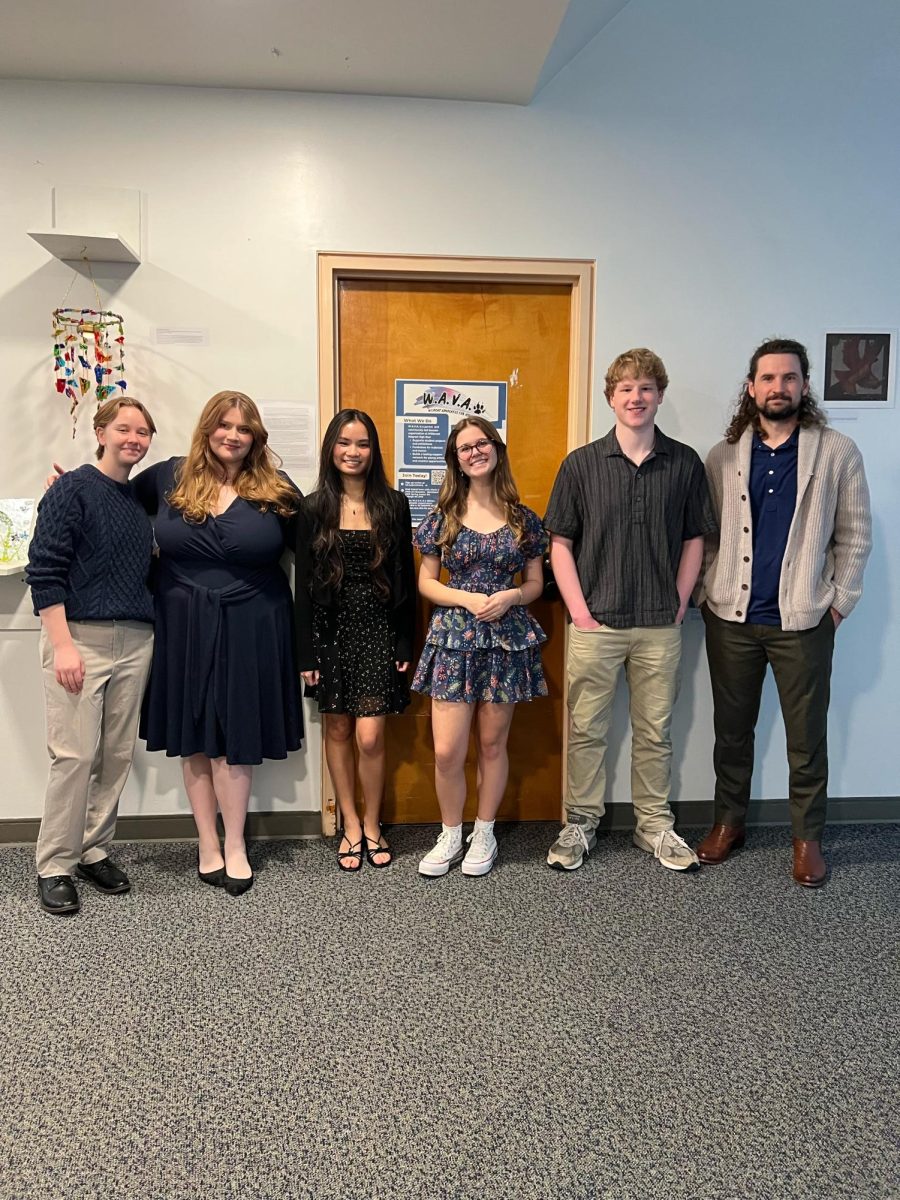
On Thursday, March 12, this year’s IB Visual Arts students presented their portfolios at the 10th annual IB Art Exhibition. This Exhibition acts as a culmination of their work from the two years IB Art students spend in the IB Diploma Programme. Each student presented pieces that they used for their final portfolio submitted to the IBO.
A class of just five seniors, IB Visual Arts teacher Mr. Davis describes them as a “great, small, tight-knit group.” Each brought unique topics and talents to the table, with works ranging from traditional portraiture to ceramic sculpture, and even kiln-glass-fused pieces. The students had to develop what is called a curatorial rationale, which is a body of text that describes their theme and approach to their art.
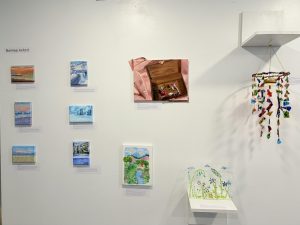
Berklee Axford described her curatorial rationale as focusing on her “personal philosophy of how art is something that should be enjoyed. […] with a process just as important as the outcome” as well as childhood memories.
Her portfolio included a series of six nature oil paintings, a water-color collage “Through a Child’s eyes”,” a mixed media oil painting titled “Her Box,” a kiln-fused glass floral mosaic with glass sourced from Berklee’s grandmother’s art collection, and another glass-fused work, a chandelier.
Axford has been painting since middle school and shifted from acrylic to oil paint in her junior year. However, this was the first year she had ever experimented with glass-fusing.
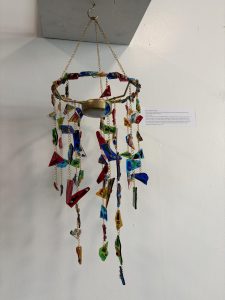
She narrated, “I am really proud of [my chandelier] because it’s never been done before at Millbrook. I independently researched how to fuse glass in a clay kiln, and my teacher had no idea how to do it. It was very stressful because if I did it wrong, the kiln is thousands and thousands of dollars. I could not have ruined it. And it ended up working out; I’ve actually never had a failure with glass fusing.”
Axford also described feeling proud that her works could each represent a different aspect of her positive personality.
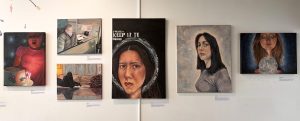
Mary Day Blakesee centered her theme around the impact of others on her life, hoping to “guide viewers through [her] personal experiences while also encouraging them to think about how their own relationships shape their identity.”
Blakesee’s exhibition is composed of six portraits, one stop-motion animation featuring 60 hand-drawn frames, and a hanging mobile. She began painting at 15 and describes her draw to portraiture as coming from her admiration for Dutch and Northern Renaissance period painters who worked between the 14th and 17th centuries, and has attributed her approach to lighting to Rembrandt and James McNeil Whistler’s techniques.
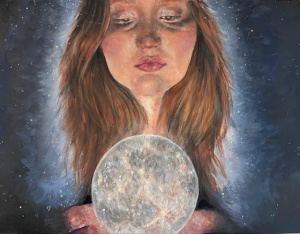
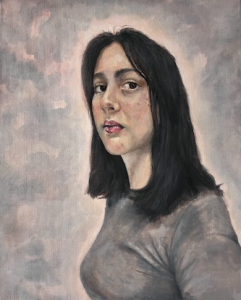
Blakesee’s favorite portfolio piece is “Portrait #1”,” a traditional portrait of one of her best friends, and it is also the first portrait she ever created. Another traditional portrait she includes is one of herself, entitled “Turning of the Tides,” where she holds a glowing moon, representing her acceptance of her femininity and womanhood.
Blakesee’s portfolio’s theme around external relationships is furthered as she references each member of her family; including paintings of her father and brother which she described as her most difficult out of her exhibition, and an animation focused on her relationship with her mother.
Blakesee’s curatorial rationale explains, “I hope the viewer can see identity as not a fixed label but something that developed through people and experiences around us.”
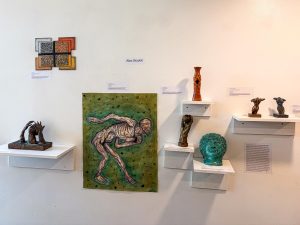
Alex Boykin’s portfolio consists of two ceramic pieces, two sculptures composed from air-dried clay and two others with a plaster cast, a large watercolor and ink painting, and an acrylic/mixed media painting. Alex described his approach as being “about how the human body can communicate internal struggle, emotional pressure, and psychological tension through distortion, posture, and physical form.”
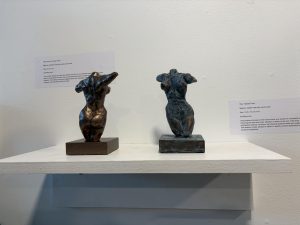
Boykin’s first time trying sculpture was within IB Visual Arts, something primarily self-taught as the IB Art teacher Mr. Davis does not typically do sculpture. He described the process for “Twisted Torso” and “Bronze Twisted Torso” as starting with polymer clay shaped based off of a back muscle diagram, not the skin, and then covering it with silicone to make a “mother mold,” which he can now use to reproduce his art and sell it commercially.
“Screaming Vase,” an orange ceramic vase, was inspired by the traditional Southern style of vases with faces on them, specifically one that Boykin saw while in Boone. Opposite of this straightforward approach to emotion, “‘Disorder’ examines internal chaos through abstraction […] representing how conflicting emotions can exist simultaneously within a person.” The piece is an acrylic painting composed of overlapping panels.
Boykin’s goal is to communicate the range of human emotions, rather than the “perfection” sometimes expected within art.
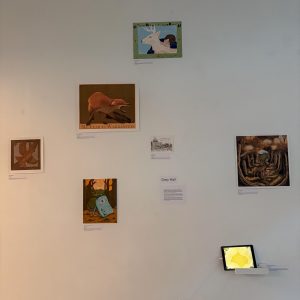
Grey Hall’s curatorial rationale is about his transgender identity. He explains, “I investigated this through several ways like inner perceptions of my identity, my childhood, familial relationships, and the political climate surrounding transgender people.”
His exhibition includes seven digital and hand-painted works. Many have serene nature backdrops, like “Journey of Identity and Finding Inner-Self” and “Closeted.” Hall’s works carry symbols of animals, like birds, deer, and rabbits. These animals are used carefully to represent different parts of his identity, like the stag representing masculinity. It appears in “Family” and “Acceptance”.”
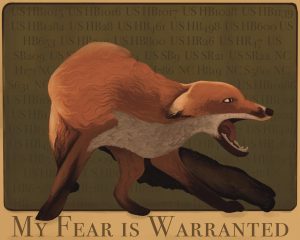
The piece Hall is most proud of is the digital painting “My Fear is Warranted”. It depicts a fox in a defensive position, snarling, with the text “MY FEAR IS WARRANTED” at the bottom of the page. Behind the fox are several federal and North Carolinian bills that target transgender rights.
Hall chose a fox, a traditional “predator” to symbolize how transgender people are often viewed as a threat. He shared, “It was my first ever finished digital piece and I was also able to post it on social media so it could fulfill its purpose of being a form of protest.”
Another notable work from Hall’s exhibition is “Protest of Pride”, an etching depicting the Capitol building that reads, “Trans people will outlive your laws.”
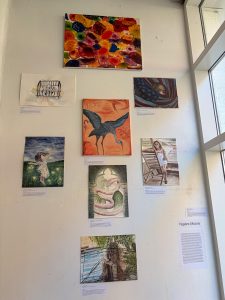
Ngaire Moore’s description of her portfolio is, “My theme is about my experience as an adopted child in a mixed-race family and how my experience with culture has been affected by that ethnic identity of being Vietnamese and Chinese, and how that affects my worldview, how I see myself and how I see the world I’ve been in.”
She explores her cultural identity and the “process of trying to accept what is, not wishing for what could have been.” Moore’s portfolio consists of both oil and watercolor paintings; “Naturalized”, “Hair Blowing in the Wind”, “The Burden”, “Watering Flowers”, “Honor to the Heron”, “Dysfunctional?”, “Looking In”, and “Fireflies and the World Before.”
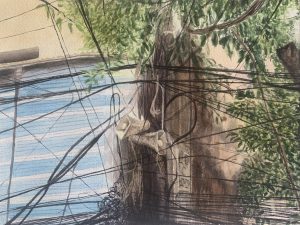
Her favorite piece is “Dysfunctional?” a watercolor painting inspired by John Singer Sargent. The piece’s tangled telephone wire represents Moore’s view of her identity as ambiguous. She shared, “I wanted to depict chaos but also functionality.”
Moore was extremely intentional with how her portfolio was arranged. The exhibition was arranged so viewers would have to physically step back to understand the full picture of her cultural identity, mirroring her own complexity. “Watering Flowers”, a colorful giclee print is highest on the wall, with the remaining works rising vertically to reflect her evolving relationship with her culture over time. The two pieces that represent her feeling distant from her culture are placed second highest, and “Honor to the Heron” (a piece dedicated to her mother’s strength and care) sits above eye level, evoking the act of bowing to give honor in many Asian cultures, and finally “Dysfunctional?” meets your eyes to represent Moore’s present idea of herself.
The 2025-2026 IB Visual Art Seniors should be proud of their unique, introspective, and dynamic portfolios! Mr. Davis shares this message with them, “I want the kids to know that I care about them. I think they’re gonna be amazing at whatever they choose to do. And I want them to always hold themselves to really high standards. I think I probably hold them to unrealistic standards sometimes, but they’re capable. And so I just want them to take that with them.”




Abrielle Myers • Mar 24, 2026 at 9:14 pm
This is so tuff