
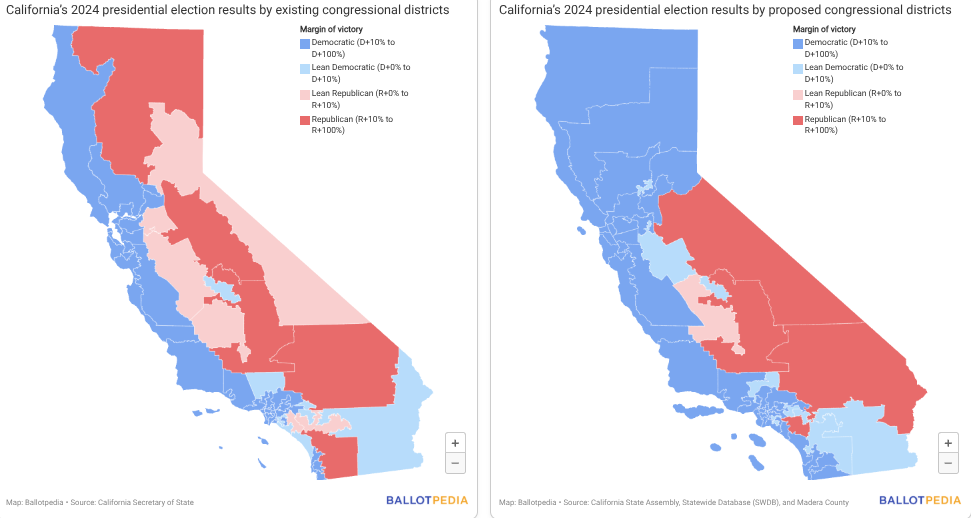
On November 4th, California voters overwhelmingly voted to pass the Election Rigging Response Act, nicknamed Proposition 50. This amendment to the California State Constitution would redraw the state’s congressional district maps. This would likely result in an additional five Democratic seats in the next house election. This partisan gerrymandering is in response to the gerrymandering done in Texas and North Carolina, which will likely increase the Republican seats in the house by nine. In these states, the legislature created and passed the bills themselves, but the Governor of California, Gavin Newsom, urged the state to ask the people’s opinion before taking it to the state legislature.
The campaigns for and against this bill were widespread and very influential. In fact, this ballot measure became the fourth most expensive in state history. Out of the $166.2 million spent for and against Prop. 50, $122.8 million was raised in support, $90 million of which Gavin Newsom raised. Millbrook AP Government teacher, Daniel Segal, says that Newsom’s campaign was likely so influential because he was able to clearly explain what the Trump administration is doing to gain votes and how this bill could offset that. Segal says, “Newsom basically framed this as, if we don’t push back on this, we [Democrats] are not going to have any say in the government.” According to Segal, “He was able to convince people that this is just us trying to level the playing field.”
These midterm votes often foreshadow the political environment for the year. They provide unique insight as to how the people are reacting to things that their representatives and other government officials are doing. These votes are especially significant when they fall so close after a presidential election as they can show the reaction of the people to what the administration is doing.
Looking at the results of this new map and similar gerrymandered ones in North Carolina and Texas, it creates a pattern. States are being made to look like almost all Republicans or almost all Democrats. Segal says, “The states that are doing this are alienating the minority.” For example in North Carolina, despite the state being relatively evenly split, 11 out of the 14 house seats are likely to be voted Republican because of the district map. As a result, Democrats in the state end up feeling underrepresented and, in Segal’s words, “drowned out.” Segal predicts that this will only create more problems between the parties. He says, “Each party’s going to accuse the other of trying to cheat and rig the election and drown out their voters.”
This process was not originally supposed to look like this. The congressional maps were originally only supposed to be drawn every 10 years following the Census. Since then, things have changed and it is a well-known fact that these maps have been used to drive political agendas instead of serving their main purpose of upholding the core value of democracy: representing the people. Segal says that personally, he thinks the state of the congressional district maps are a disaster. He says, “The right thing is not trying to steal votes and misrepresent people.” However, he also acknowledges how the 10th Amendment gives the states power to handle their own business and at the end of the day, they have the right to do that.
Right now, excessive gerrymandering is only being offset with more gerrymandering. Is this the right thing to do? What can be done to create maps that avoid gerrymandering? Segal says that a bipartisan commission should be created. Not one made of politicians, but instead made of people working for a council outside of the state. These commissions could look past the politics and geographically split up the state. Obviously there is no way to truly eradicate all political pressures, but Segal argues this could be the start.
Despite differing political views, it is important to look at what this means for every citizen long-term. Your vote is being manipulated to fit someone’s political agenda. Who’s to say how far that can and will go?