
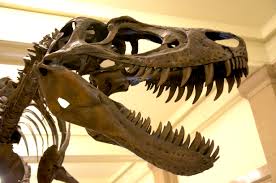
On Thursday, October 30th, 2025, Lindsay Zanno, James Napoli, and an associate research professor from North Carolina State University published a study about what is considered the biggest dinosaur discovery of the century. The North Carolina Museum of Natural Sciences published an article following the study, both of which confirmed the existence of Nanotyrannus, a subspecies of the Tyrannosaurus family that has been part of one of paleontology’s longest-running debates.
Nanotyrannus is a genus of the tyrannosauroid family. The subspecies lived within western North America during the Late Cretaceous period. The first of the Nanotyrannus species was recorded in 1946, by Charles W. Gilmore, an American paleontologist who was known for his early 20th-century work on vertebrate fossils and the naming of many dinosaurs. According to Wikipedia, when Gilmore made his discovery based on a single skull, he described it as a new species of Gorgosaurus. Robert Bakker, Micheal Williams, and Philip Currie re-examined the skull in 1988 and determined that the specimen belonged to a new genus of tyrannosaurid. Bakker, Williams, and Currie named the species Nanotyrannus because of its small size, especially when compared to other Tyrannosaurids.
Until recently, paleontologists were debating whether Nanotyrannus was its own distinct species or simply a juvenile Tyrannosaurus Rex. Thanks to Zanno and her colleagues, we finally have an answer.
In November of 2020, the North Carolina Museum of Natural Sciences received the Dueling Dinosaurs fossil. The specimen originated from the Hell Creek Formation in Montana and was discovered in 2006. The Dueling Dinosaurs fossil depicts both a Triceratops and what has now been confirmed as a Nanotyrannus. According to Zanno, she and her team used this fossil to, “What we did is we made sections of the limb bone and preserved in the limb bones of dinosaurs are rings that are just like the rings of a tree that are laid down each year.” Zanno also stated that she and her team counted the rings to determine the age of the dinosaur specimen. In doing so, they determined that the preserved specimen was at least 14 years old when it died.
“This is an individual that was almost as big as it was ever going to grow when it died,” said Zanno in an interview with the North Carolina Museum of Natural Sciences. If Nanotyrannus was a juvenile T. Rex, it would’ve had much more growing to do. These findings led Zanno and her team to conclude that Nanotyrannus was, in fact, its own separate species.
The findings that Zanno and her team have presented are considered incredibly important to many paleontologists. According to NaturalSciences.Org, “For years, paleontologists used Nanotyrannus fossils to model T.Rex growth and behavior. This new evidence reveals that those studies were based on two entirely different animals – and that multiple tyrannosaur species inhabited the same ecosystems in the final million years before the asteroid impact.”
Little is known on just how much research on T. Rex growth and behavior patterns have become invalid due to these findings. Regardless, Zanno, Napoli, and their associates have presented priceless information to the paleontological world. Information that could change the way we think about the Tyrannosaurus species forever.