
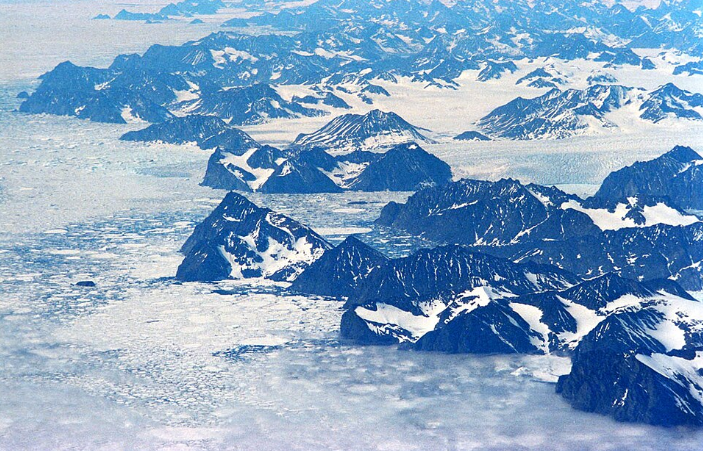
For decades, Greenland was a geopolitical afterthought. It was 836,000 square miles of ice that the rest of the world never really cared about. But as the Arctic warms four times faster than the rest of the planet, the ice is melting, revealing new trade routes and critical raw minerals. Greenland has spent centuries being ignored, but now it holds power, and the United States, Russia, and China are all trying to secure the leverage it offers.
While Greenland does have a history with the U.S., it was purely for military convenience. In 1941, the U.S. took over the island while the Danish Government was under Nazi occupation. Because of its proximity to the United States, the U.S. feared a Nazi takeover, constructing 17 facilities, and using the island as a military advantage. As the Cold War began, Greenland’s value grew once again. The U.S. used Greenland to install radar systems to detect Soviet bombers coming over the North Pole. However, when the Soviet Union collapsed in 1991, the United States no longer deemed Greenland as useful. They famously handed the base at Kangerlussuaq back to the local government for $1 in 1992. They left behind abandoned equipment and toxic waste, assuming the Arctic would stay frozen and irrelevant.
In 2018, the ice was retreating, and China saw an opening. They wanted to make a “Polar Silk Road,” calling themselves a “Near-Arctic State.” China tried to fund three massive airport expansions in Greenland, as Greenland desperately wanted to develop more travel options. The nation wanted these airports to build their own economy, helping them with their journey to become independent from Denmark. The U.S. and Denmark saw this as a debt trap move by China to secure a foothold on Greenland, an area close to the U.S. border. The United States government pressured Denmark to kill the deal, forcing the Danes to scramble and provide the funding themselves.
However, the real war is over Greenland’s minerals. Recently, a Chinese firm tried to take over a lead and zinc mine in the far north. It was almost a done deal until the U.S. stepped in. To ensure the mine didn’t fall into Chinese control, the U.S. government backed an equity deal. The deal included terms for a Western firm to receive a massive injection of capital, including a $650 million “interest” move to keep the project in the “Western” column.
While the U.S. buys influence, Russia has its own strategies. They have reopened over 50 Cold War-era military outposts across the Arctic frontier and famously planted a Russian flag on the floor of the North Pole. However, at a 2026 Russian Security Council, Vladimir Putin stated, “What happens in Greenland is of no concern to us whatsoever.” Russia has also been increasing its security presence to deal with the effects of global warming. The melting ice has created a situation where Russia has to defend its northern border. Similarly, the United States Coast Guard is planning to spend $7.8 billion on new Arctic-trained fleets in 2026.
In 2019, Donald Trump turned Greenland into a headline upon trying to buy the island. However, what was once seen as real estate has now turned into a threat in his second term. By early 2026, he stated he would obtain Greenland “one way or the other” and that if a deal wasn’t made the “easy way,” it would be done the “hard way.” Threats like these have also led to discussions about the upcoming World Cup hosted by the United States. The German Football Association (DFB) has declared that it will consider withdrawing from the World Cup if the United States acts on these threats and goes through with invading Greenland. While recent discussions at the 2026 World Economic Forum have shifted toward a “cooperative framework,” the underlying pressure remains aimed at ensuring Greenland’s strategic position and mineral wealth stay under Western influence rather than drifting toward Chinese or Russian control.
Greenland’s population is only about 56,000 people, but it sits on the world’s most strategic geography. They know the United States needs them for defense, China for resources, and Russia for control. The map has shifted. The same island where the U.S. once handed back bases for a dollar is now declaring its own rules, forcing world powers to pay billions for a seat at the Arctic table.