The University of North Carolina at Chapel Hill (UNC) has long been considered among the best of the South, a reputation solidified by Forbes naming it a “New Ivy.” However, this newfound status has been blurred by recent controversies that have left the university’s reputation under pressure.
From a yearly satirical newspaper published on April Fools’ Day that sparked fear across campus to a viral video full of racial insensitivity, UNC is facing an identity crisis. What was supposed to be a season of celebration for the university and its incoming freshmen has instead highlighted divisions across campus.
In response to the backlash, on April 8, 2026 The Daily Tar Heel and its Editor-in-Chief, Allie Pardue, issued an apology calling the recent satirical issue a “colossal, institutional failure.” The paper admitted that its content resulted in the marginalization of the communities it intends to support. In response to the injury, Senior Vice Provost James Orr clarified that while the paper runs independently, the content was “highly inappropriate” and “offensive.”
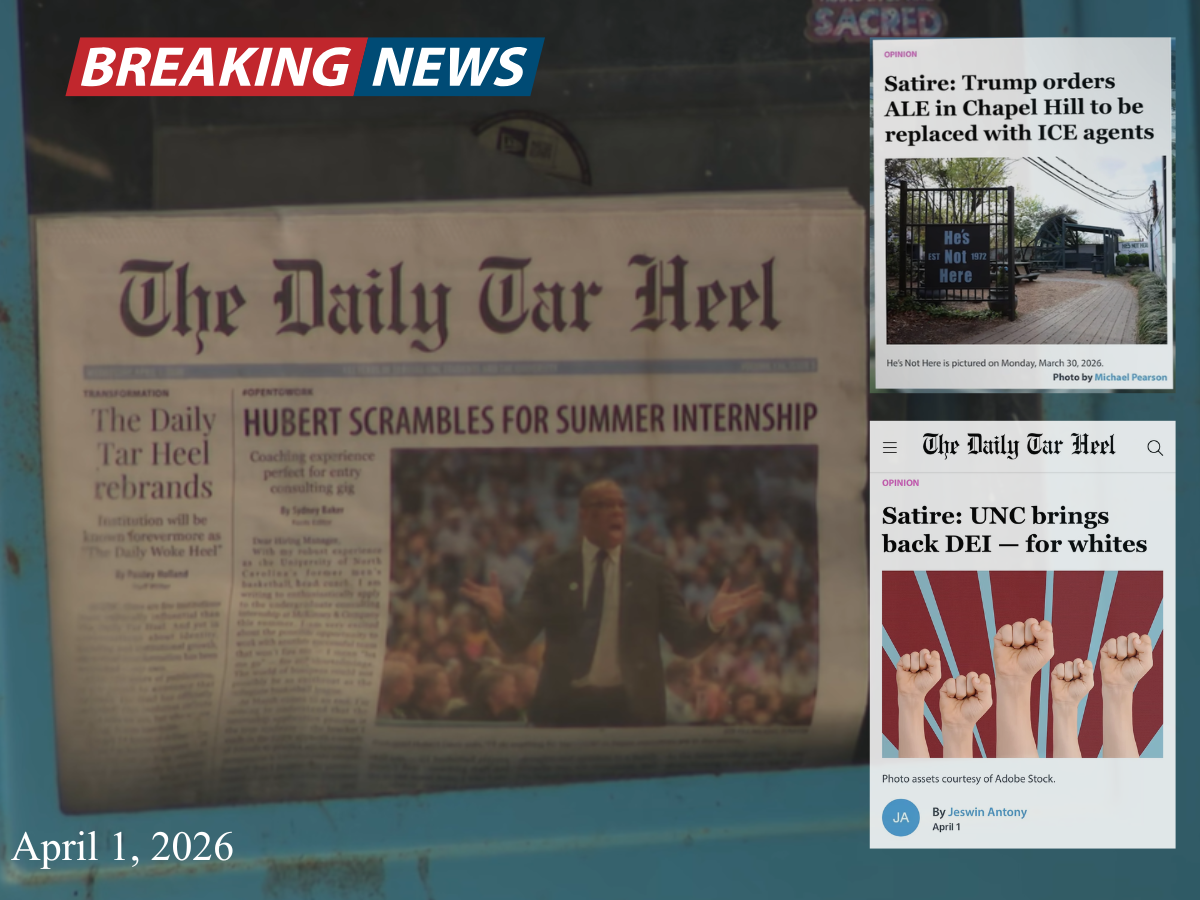
The controversy centered on The Daily Tar Heel, some temporarily titled “The Daily Woke Heel,” which released several satirical headings that not only missed their mark but caused genuine fear amongst students. The article in question held a headline titled “Trump orders ALE in Chapel Hill to be replaced with ICE agents,” while another claimed “UNC brings back DEI – for whites.” Because the “ICE” headline was not explicitly marked as a satire, many students panicked before realizing it was supposed to be a joke.
This insensitivity mirrored a trend set by the “Hill After Hours” inflammatory video. In the now deleted video, three white students mock the South Campus by calling it a “third world country” and a “desert” that spreads sepsis. The video culminates blatant racial mockery in a scene where a girl yells in a person of color’s face, acting as if he could not understand her.
For many, the recent controversies have led to uncomfortable reflection. Claire Metz, a UNC student, described the student body’s recent behaviour as “quite frankly really embarrassing,” noting that it reflects poorly on the school. Metz fears actions like this may turn applicants away. While she acknowledges the American tradition of “falling head over heels” for one’s college, she emphasizes that it is important to “stop putting universities on a pedestal and hold them accountable.”
Similarly, for junior Sophia de Vries, the video was extremely problematic. She was concerned that “The Hill After Hours” portrayed the campuses as “super divisive” and “perpetuated really hateful stereotypes,” adding that these depictions may lead to students of color feeling scared and excluded. Beyond the social impact, de Vries felt that The Daily Tar Heel was trying to make a mockery of student activism. Ultimately, many students fear that such depictions prioritize entertainment over the student body.
To understand the gravity of the two instances, many point to the university’s social and geographical history. Historically, since Black students were first admitted in the 1950s, a divide between the north and south side has persisted. Traditionally, the older dorms on north campus housed a predominately white population. South campus, separated by a 25-minute walk, became a place that typically houses freshmen, athletes and students of color. This historical context is what the “Hill After Hours” video poked fun at.
Ultimately, many students fear that such depictions prioritize entertainment over the well-being of the student body. While the paper is independently run, students worry that this behavior may lead to a lack of trust in campus journalism and raise uneasiness among the incoming freshman class.